

For a while, I practiced meditation with a group. Same place, same time, same people, several times a week.
Those sessions gave me something I couldn’t have found in a book. I learned what a quiet mind actually feels like. Not the forced silence of trying hard not to think, but a state some traditions call no-mind: thoughts come and go, and nothing grabs you. Along with it came a calm, clean kind of energy. It wasn’t a buzz or excitement. It felt more like being fully present in my own body.
Then life changed. My working schedule shifted, some personal circumstances changed, and the group sessions no longer fit. I told myself I would keep practicing on my own, whenever I had time.
You can probably guess how often that time appeared.
Looking back, the group gave me more than guidance. It gave me a structure. The time was set, the place was set, and all I had to do was show up. Without that, the practice slowly faded, and so did the clarity that came with it.
Why “Whenever I Have Time” Never Works
“I’ll meditate when I have time” sounds reasonable. The problem is that it’s a decision you have to make again every single day. And you usually make it at the worst possible moment: when you’re tired, busy, or scrolling your phone late at night.
A tired brain almost always picks the easier option. That’s not laziness. Willpower is simply a poor way to plan your day. Good intentions compete with everything else, and everything else usually feels more urgent.
A fixed time removes that daily negotiation. At 8:00, after your shower, you breathe for five minutes. The question is no longer “should I?” It’s just “it’s 8:00.”
The Science of Showing Up
Psychology has studied this for decades, and the findings are encouraging.
Habits are built by repetition in the same context. In a well-known 2010 study from University College London, researchers followed 96 people who picked a new daily behavior, like drinking water after breakfast or going for a run before dinner. On average, it took about 66 days for the behavior to become automatic, although it ranged from 18 to 254 days depending on the person and the habit.
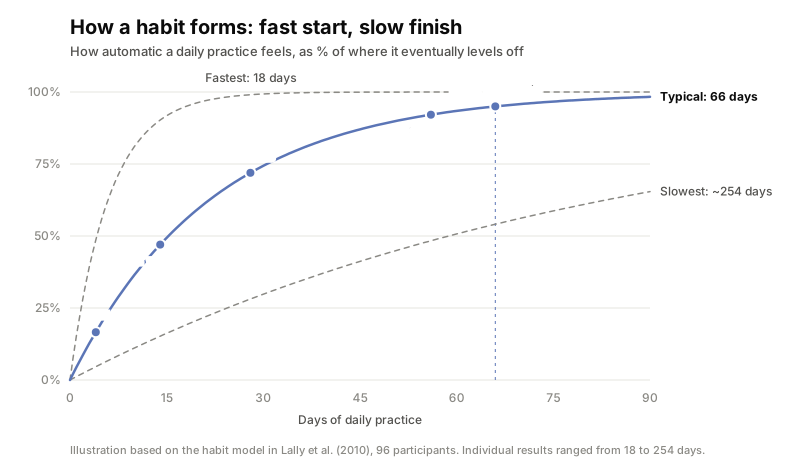
One small detail matters a lot: missing a single day did not meaningfully affect the process. The habit didn’t reset. You don’t need a perfect streak. You just need to keep coming back.
“When and where” beats “I’ll try.” Psychologists call it an implementation intention: a simple plan in the form “When X happens, I will do Y.” A large review of 94 studies found that people who made plans like this were much more likely to follow through on their goals than people who relied on good intentions alone.
“I want to meditate more” is an intention. “After I brush my teeth in the evening, I do three minutes of slow breathing” is a plan. Your brain can follow a plan.
Why the Quiet Mind Fades Without Practice
Remember that no-mind state from the group sessions? It turns out science has a name for its opposite.
Harvard researchers found that our minds wander almost half of our waking hours, and that we tend to feel less happy while they do. All that replaying, planning, and worrying runs on a brain system called the default mode network, which is basically your mental autopilot. In experienced meditators, this network is noticeably quieter.
The key word is experienced. A quiet mind is less like a place you visit and more like a skill you keep. When you stop practicing, the autopilot slowly takes over again. That’s exactly what happened to me after the group.
The good news is that you don’t need hours to get it back. In one study, complete beginners meditated for just 13 minutes a day. After 8 weeks, they were calmer, less anxious, and sharper at attention and memory tests. At 4 weeks, there was no difference yet. Short sessions worked. What mattered was coming back every day.
So what actually changes, and when? Here’s roughly what research suggests as practice adds up.
-
First few sessions
What you may notice
More awareness of your thoughts, moments of calm, and an easier time returning attention to the present.
Even brief practice can bring a small, short-lived lift in mood and stress. Lasting changes take longer.
In your brain
Your brain is practicing attention. Each time you notice your mind wandering and come back, you're exercising attentional control.
-
About 2–4 weeks
What you may notice
Greater awareness of automatic thoughts and reactions. Sitting down to practice may start to feel more familiar.
In the 13-minute study, beginners showed no measurable difference yet at 4 weeks. Early progress is real, but often too subtle to show up on tests. This is the stage to keep showing up.
In your brain
Repetition turns meditation into mental training. You're repeatedly practicing noticing, letting go, and redirecting attention.
-
About 8 weeks
What you may notice
Feeling calmer and less anxious, with sharper attention and memory and a more measured response to stress.
Beginners who meditated 13 minutes a day for 8 weeks improved their attention, memory, mood, and response to acute stress.
In your brain
Practice starts producing measurable changes in how your mind responds. That's stronger evidence than claims about a specific brain region "growing."
-
2–3 months and beyond
What you may notice
Around the time a habit usually becomes automatic (about 66 days on average), practice starts to feel less like a decision. Pausing before reacting may get easier outside of meditation too.
Sustained practice is linked to less stress, anxiety, and distress, and a better quality of life, though effects differ between people and studies.
In your brain
A practiced skill gets easier to use in everyday life. The goal isn't to get rid of difficult emotions, but to change your relationship with them.
-
Long-term practice
What you may notice
Greater awareness, steadier emotions, and an easier return to the present after distraction or stress.
Neuroimaging research has found differences in brain activity and connectivity among meditators, and some studies report structural differences.
In your brain
This is where neuroplasticity becomes relevant. Repeated practice is linked to changes in brain function, and possibly structure, but there's no universal timeline or guaranteed outcome.
-
Years of consistent practice
What you may notice
Meditation may become less something you "do" and more a practiced way of relating to thoughts, emotions, and stress.
Long-term meditators can show distinctive patterns of neural activity in networks involved in attention, self-referential thinking, and emotion.
In your brain
Long-term practice may leave lasting neural adaptations. The exact mechanisms and causes are still being studied.
Start With One Moment
Forget the perfect morning ritual. Pick one moment that already happens every day and attach a few minutes of practice to it:
- After your shower: 3 minutes of slow breathing.
- After lunch: a short grounding break before the afternoon pulls you under.
- Before bed: something slow and tactile, like calligraphy tracing, or a few rounds of longer exhales.
Just one. Add a second only when the first one happens without thinking.
And when you miss a day, and you will, don’t start over and don’t try to make up for it. Just show up at the next usual time. Coming back after a break is the same thing you practice with every wandering thought, only on a bigger scale.
Bringing the Structure Back
Looking back, what I missed most after the group wasn’t the teacher or the room. It was the rhythm: a set time and a quiet reason to show up.
That’s what Routines in Calmisu are for. You choose a practice (breathing, meditation, calligraphy, or grounding) and a time that fits your day. Calmisu gently reminds you when it’s time. There are no streaks to break and no guilt.
The decision is already made. All you have to do is show up.
FAQ
The one you can repeat. Mornings work for many people, but an evening routine is just as valuable, especially if you struggle to fall asleep.
Find your center with Calmisu.
Guided breathing, grounding, calligraphy, and meditation — free to download.