
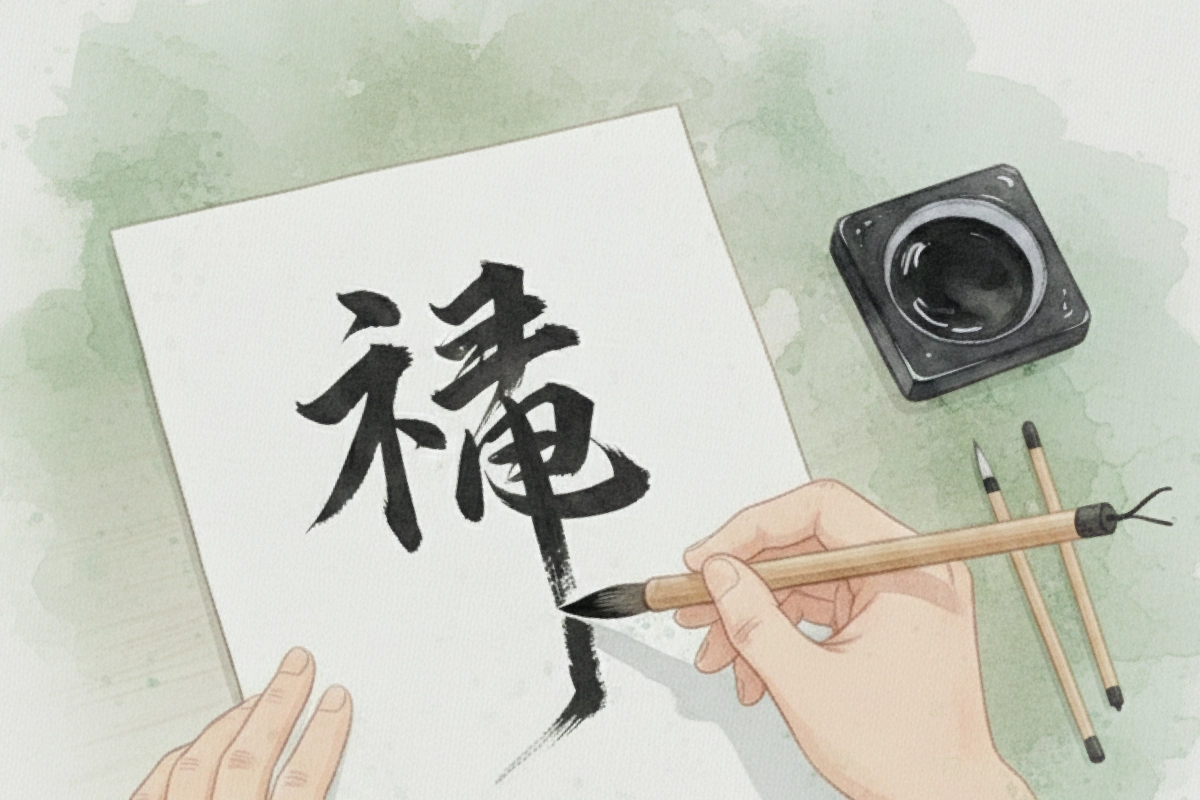
I was 13 years old when I first picked up a brush.
At the time, my motivations weren’t particularly spiritual. I had started taking aikido classes primarily to protect myself from school bullies and, if I’m being completely honest, to look cool. Like a lot of teenagers, my passions burned bright and faded fast; most of my hobbies from that era vanished as quickly as they appeared.
Yet, as part of the dojo’s wider cultural introduction, we were taught how to write a few basic kanji using real brushes.
While the martial arts moves eventually grew rusty, something about that specific ritual stuck. Decades later, I can still vividly recall the physical reality of it: the pure, textured crispness of the paper, the deep charcoal color of the ink blooming across the fibers, the “imperfect perfection” of a stroke made by an unsteady hand, and that distinct, earthy smell of wet ink. It was a sensory imprint that stayed buried in the back of my mind for years.
The Novel Discovery
It wasn’t until much later in life, while reading a novel, that I stumbled across a description of calligraphy that stopped me in my tracks.
The characters weren’t just practicing a writing system; they were treating brushwork as a moving meditation. The book described how, with decades of rigorous practice, a calligrapher could achieve a “no-mind” — a state of pure presence where ego dissolves, and the stroke writes itself. Enlightenment, the text suggested, wasn’t found by emptying the mind through sheer willpower, but by channeling the entire consciousness into the tip of a single brush hair.
It made me look back at my 13-year-old self in a completely different light. Without realizing it, I had tasted a tiny fragment of an ancient contemplative tradition.
The Zen Art of the Brush
Japanese calligraphy, known as shodō (書道, “the way of writing”), has roots in Chinese calligraphic traditions and developed its own distinct forms in Japan. Over time, it also became deeply intertwined with Zen Buddhism, particularly in the work of Zen monks and in traditions of expressive brushwork.
Within Zen communities, brushwork could serve purposes far beyond decorative writing. Calligraphy became one way of expressing concentration, spontaneity, and the practitioner’s state of mind.
Hitsuzendō (The Way of the Brush) is a modern Zen-influenced approach to calligraphy associated with Yokoyama Tenkei and later developed by Ōmori Sōgen. Rather than treating the brushstroke simply as a finished piece of writing, the practice emphasizes the act of writing itself as a form of Zen practice.
Mushin (No-Mind) is one ideal associated with Zen-influenced brushwork: a state in which conscious hesitation and self-conscious calculation recede, allowing the movement to become more immediate and unified.
The ensō (円相), the hand-drawn Zen circle, became one of the most recognizable forms of Zen brushwork. Often created in a single spontaneous stroke, it has been associated with ideas of enlightenment, emptiness, and the totality of experience.
Why the Brush Can Feel Like Meditation
Why does dragging a piece of carbon-infused water across paper have such a profound calming effect on an overactive modern brain? It comes down to a few distinct cognitive mechanisms:
- Tactile and Visual Attention. Calligraphy gives the hands, eyes, and body a continuous physical task. You feel the brush move across the paper, watch the ink spread, and adjust pressure and movement in real time. That combination can pull attention away from abstract thought and toward the immediate task.
- Fine-Motor Attention. A controlled brushstroke requires coordination between vision, hand movement, posture, pressure, and timing. The more demanding the stroke, the more attention it can require.
- Embracing Imperfection. A brushstroke cannot simply be undone. If the ink spreads too far or the line wobbles, the mistake becomes part of the finished piece. That makes calligraphy an unusually concrete exercise in letting an imperfect moment remain imperfect.
Modern Echoes: Finding Your Tactile Anchor
You don’t need to master kanji or join a Zen monastery to harness this kind of meditative focus. Across modern therapeutic and artistic spaces, people are rediscovering the power of tactile, analog creation as a counterweight to digital exhaustion.
- Watercolor and palette knife painting — working with fluid mediums forces you to watch the physics of water and pigment, anchoring your attention to the physical material.
- Pottery and ceramics — shaping clay on a wheel requires the same blend of posture, breath, and micro-movements found in brushwork.
- Slow journaling or mindful doodling — even structured, low-friction writing or repetitive pattern-making can serve as a mental circuit-breaker at the end of a high-stress day.
You never quite know which physical ritual will click for your nervous system. For me, it started as a clumsy attempt to look tough at 13, but it left behind a lifelong lesson: sometimes the fastest way to quiet a chaotic mind is to pick up a tool, touch a piece of paper, and let the ink do the talking.
Find your center with Calmisu.
Guided breathing, grounding, calligraphy, and meditation — free to download.