
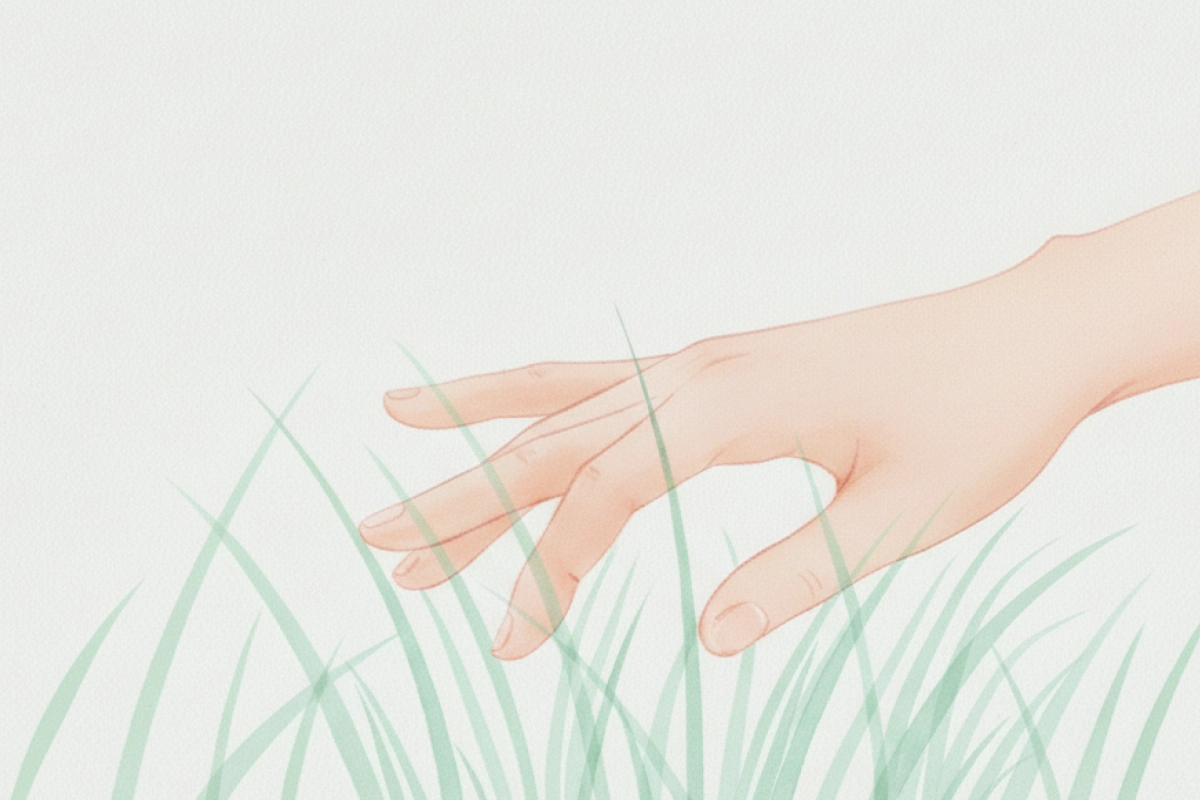
If you spend enough time in the combative corners of the internet, you will eventually see someone told to “go touch grass.” Deployed as an insult, it implies that someone is chronically online, obsessing over digital trivialities, and entirely disconnected from physical reality.
Yet, stripped of its sarcasm, the basic idea behind “touch grass” overlaps with established grounding and attention-based techniques.
When an individual spirals into panic, the brain becomes trapped in abstract, future-oriented threats. One way to interrupt that cognitive loop is through immediate sensory attention. Long before it was an internet meme, this was a grounded psychiatric tool. In the mid-20th century, psychotherapist Alexander Lowen developed Bioenergetic Analysis, a body-oriented approach that emphasized grounding and physical contact with the floor. In trauma-informed and anxiety-focused approaches, grounding techniques are used to redirect attention toward present sensory information — physical sensations such as touching an object or noticing the feeling of the ground beneath your feet.
The Neurological Override: Why Hands Stop the Spin
Why does dragging a hand through dirt or holding grass interrupt anxiety so effectively? The secret lies in how the human brain manages processing bandwidth.
Your fingertips contain some of the body’s densest concentrations of tactile receptors. When you force your hands to engage with complex natural textures, you initiate a rapid neurological sequence:
- The sensory hijack. Mechanoreceptors in the skin register dampness, temperature, and sharpness. This sends high-priority data straight to the brain’s somatosensory cortex, demanding immediate processing.
- The proof of the present. Sensory attention can compete with anxious rumination for attention, giving the mind something immediate and concrete to focus on.
The Barefoot Anchor: Finding the Floor
If your hands act as a sensory circuit-breaker, your feet act as a structural anchor.
During an acute spike of anxiety, a very common physical symptom is dissociation — the sudden, dizzying sensation of floating, spinning, or feeling completely untethered. The panicked brain has lost its sense of physical context; it feels like you are falling, even if you are sitting still.
When you stand barefoot on an uneven surface, your nervous system receives proprioceptive information about the position and movement of your feet and body, along with tactile information from the soles of your feet. Your toes and arches must grip and flex to maintain balance.
It is the same biological mechanic that makes people instinctively pace when stressed, or why curling your bare toes tightly into a carpet (a trick famously referenced for travel anxiety in the movie Die Hard) feels inexplicably calming. The physical sensation of standing on a stable surface can give your attention something concrete to focus on, while the small adjustments required for balance keep you connected to your body and surroundings.
The Color of Safety: The Optical Science of Leaves
Grounding is equally about what happens visually when you step outside. Why “touch grass” instead of touching a concrete wall? The answer may have less to do with the color green itself than with the way natural environments engage our attention. Unlike a screen, a natural landscape offers a constantly changing mixture of shapes, movement, depth, texture, and sound. Some theories of attention restoration propose that these environments can hold our attention without demanding the same sustained, directed effort required by many everyday tasks.
The human mind is not an abstract entity floating independently of biology; it is directly tethered to a physical frame. The next time a mental spiral takes over, taking off your shoes and stepping outside isn’t a surrender. It is an ancient, biologically sound circuit-breaker.
Find your center with Calmisu.
Guided breathing, grounding, calligraphy, and meditation — free to download.